Are you curious about how shapes transform into 3D objects? Ever wondered how to measure the space they occupy?
Finding the volume of a solid generated by cross sections might sound complex, but it’s simpler than you think. This process is not just for mathematicians; it’s for anyone eager to understand the world around them. By mastering this skill, you’ll unlock new ways to visualize and solve real-world problems, from engineering to everyday tasks.
Dive into this guide, and you’ll discover straightforward steps that make this seemingly daunting task manageable and even enjoyable. Ready to expand your understanding and gain a new perspective on geometry? Let’s explore how you can easily find the volume of these intriguing solids.

Credit: www.teacherspayteachers.com
Understanding Cross Sections
Finding the volume of a solid generated by cross sections involves integrating the area of slices. By using geometric shapes like squares or semicircles, the process calculates the space within the solid. Understanding this method is essential in geometry and calculus for precise volume measurements.
Definition Of Cross Sections
A cross section is a slice of a solid. It shows the shape inside. Imagine cutting an apple. You see the seeds. The cut part is the cross section. Cross sections help find volume. They reveal the inside shape. Every solid has different cross sections. These sections can be simple or complex. Understanding them is key to solving problems.
Types Of Cross Sections
- Rectangular Cross Section: Looks like a rectangle.
- Triangular Cross Section: Looks like a triangle.
- Circular Cross Section: Looks like a circle.
- Elliptical Cross Section: Looks like an ellipse.
Different solids have different cross sections. Shapes can change based on where you slice. Each type helps in measuring volume accurately.
Methods Of Volume Calculation
The disk method uses circular cross-sections. Imagine slicing a solid into thin disks. Each disk has a small width. The formula for volume is: V = π∫[a,b] (radius)^2 dx. The radius is the distance from the axis to the edge. This method works well for solids with a known axis of rotation.
The washer method is similar to the disk method. It considers a hole in the center. The formula is: V = π∫[a,b] [(outer radius)^2 – (inner radius)^2] dx. This method helps find volumes of solids with hollow centers. The outer and inner radii are key.
The shell method wraps the solid in cylindrical shells. Picture stacking many thin shells. The formula is: V = 2π∫[a,b] (radius)(height) dx. This method is useful for finding volumes around vertical axes. It uses the cylinder’s height and radius.
Steps To Calculate Volume
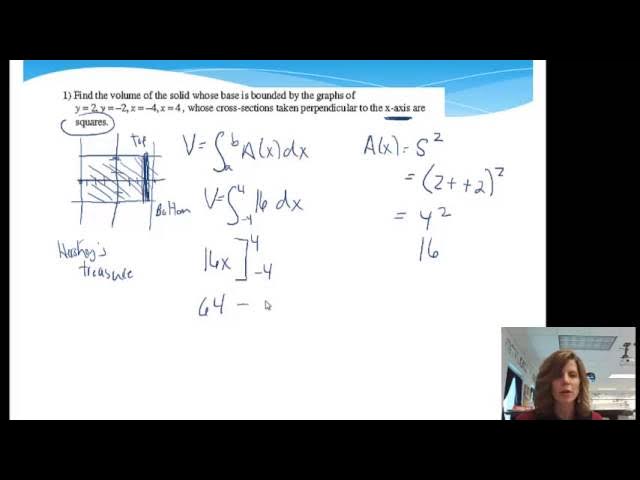
First, identify the shape of the cross-section. It could be a circle, square, or triangle. Write the formula for the area of this shape. For a circle, use πr²; for a square, use s². Determine the limits of integration. These are the start and end points of the solid. Now, set up the integral. Multiply the area formula by dx or dy. The integral will represent the volume.
Integrate the equation to find the volume. Use basic integration rules. Evaluate the integral from the lower to upper limit. This will give you the total volume. Check your work to ensure it’s correct. Adjust any errors in the setup. Confirm the units are consistent. The volume is now calculated.

Credit: wayground.com
Applications In Real-world Problems
Finding the volume of solids generated by cross sections involves integrating the area of each slice. This method applies to real-world problems like designing tunnels or calculating reservoir capacities. Simple formulas and calculus can help visualize and solve these challenges effectively.
Engineering And Design
Engineers use solid volume calculations for creating strong structures. Buildings and bridges need accurate measurements. Designers rely on these calculations for crafting precise models. 3D printers also need this data for perfect shapes. It ensures parts fit well together. Architects use it for landscape planning. Volume helps in materials estimation. Proper estimation saves costs and resources. Engineers trust these calculations for safer designs. It prevents construction mishaps.
Medical Imaging
Doctors use volume calculations in imaging. CT scans and MRIs create detailed images. These images show organs and tissues. Calculating volume helps in diagnosing diseases. It assists in tracking tumor growth. Accurate measurement is vital for treatment plans. Surgeons rely on these details for operations. It helps in planning precise surgical cuts. Doctors can monitor patient progress effectively. Volume data aids in patient recovery.
Common Challenges And Solutions
Some shapes are tricky. Imagine a star or heart. Finding volume gets tough. Break the shape into simpler parts. Use rectangles or triangles. Calculate each part’s volume. Add them up. This makes it easier.
Integration can be confusing. It involves calculus. Mistakes happen easily. Double-check your formulas. Practice using simple examples first. Computers help too. Use software for accuracy. This reduces errors.
Credit: ispeakmath.org
Tips For Accurate Calculations
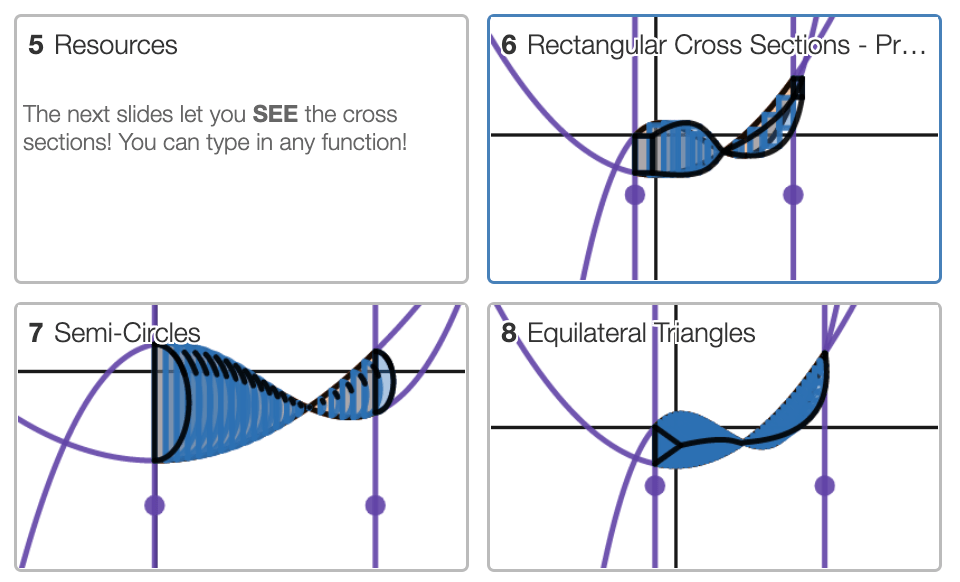
Finding the volume of solids generated by cross sections involves integrating the area of each section. Visualize the shape and identify its basic geometric form. Use the appropriate formula to calculate the area of each cross section and integrate over the given interval.
Choosing The Right Method
Pick a method that suits the shape of the solid. Some shapes are best with disk method, while others fit washersor cylindrical shells. Know the formulafor each method. Understand how to use the axis of rotation. This helps in accurate calculations. Always check if the shape matches the method.
Checking Your Work
Review your steps carefully. Look at each number you used. Make sure calculations follow the formula. Double-check by using a different methodif possible. Errors can happen easily. Check your work with a calculator. Accurate calculations save time and trouble.
Recommended Resources
Explore essential resources to understand the volume of solids created by cross sections. Enhance your learning with interactive tools, step-by-step guides, and visual aids.
Books And Texts
Books can help you understand volume of solid shapes. Math textbooks explain solid shapes and volume. Geometry books are helpful too. They show drawings of solid shapes. Some books have practice problems to solve. Libraries often have many math books. You can borrow them for free. You can also buy books at bookstores. Online stores sell math books too. Buy them with a click.
Online Courses And Tutorials
Online courses teach volume of solid shapes. Video tutorials show how to find volume. Some courses are free. Others may need payment. Websites like Khan Academy offer free learning. YouTube has many helpful videos. They explain volume clearly. Interactive websites have exercises. They make learning fun. You can learn at your own pace. Choose courses that fit your learning style.
Frequently Asked Questions
How Do You Find The Volume Of A Solid With A Cross-sectional Area?
To find the volume of a solid with a cross-sectional area, integrate the area function along the solid’s length. Use definite integrals to calculate the total volume. This method is ideal for solids like cylinders and prisms. Ensure the cross-sectional area is perpendicular to the solid’s axis.
How To Find Volume Using Cross Product?
To find volume using cross product, calculate the cross product of two vectors to get a new vector. Then, find the dot product of this new vector with a third vector. The result gives the volume of the parallelepiped formed by the three vectors.
How To Find The Volume Of An Object With A Constant Cross-section?
Calculate the cross-sectional area first. Multiply the area by the object’s length to find the volume. For cylindrical objects, use πr² for the area. Ensure measurements are accurate for precise volume calculation. This method applies to objects with uniform cross-sections like cylinders, prisms, and pipes.
How To Calculate The Volume Of Solids?
Calculate the volume of solids using specific formulas. For cubes, use side³. For rectangular prisms, use length × width × height. For cylinders, use π × radius² × height. For spheres, use (4/3) × π × radius³. Utilize the appropriate formula based on the solid’s shape for accurate results.
Conclusion
Understanding the volume of solids by cross sections is crucial. It simplifies complex geometry problems. Practice with different shapes to enhance your skills. Visualize the solid and its cross sections. This approach helps in grasping the concept better. Remember, consistency is key in learning.
Use available resources like textbooks and online tutorials. They provide a wealth of examples and exercises. Keep experimenting with problems. Over time, your confidence will grow. Soon, you’ll find these calculations much easier. Stay curious and keep exploring new mathematical challenges.