Have you ever wondered how to find the volume of a solid created by rotating a shape or combining different figures? Understanding this concept can unlock a whole new level of problem-solving in math and engineering.
Whether you’re a student tackling homework or someone curious about how things work in the real world, knowing how to calculate these volumes is a powerful skill. You’ll discover clear, simple ways to figure out the volume of solids generated by various methods.
Ready to boost your confidence and make tricky problems easier? Keep reading—you’re about to master a key concept that will help you in many areas.

Credit: www.youtube.com
Volume Of Solids Basics
Solids can be simple shapes like cubes and spheres or complex ones like cones and cylinders. Each solid has a specific way to find its volume. Volume tells how much space the solid takes up. It is measured in cubic units such as cubic meters (m³), cubic centimeters (cm³), or cubic inches (in³).
| Type of Solid | Description | Example |
|---|---|---|
| Cube | All sides equal length | Dice |
| Sphere | Round shape, like a ball | Basketball |
| Cylinder | Two parallel circular bases | Can of soda |
| Cone | One circular base, tapers to a point | Ice cream cone |
Methods To Calculate Volume
Using geometric formulasis the easiest way to find volume. Shapes like cubes, cylinders, and spheres have fixed formulas. These formulas use measurements like radius, height, and length.
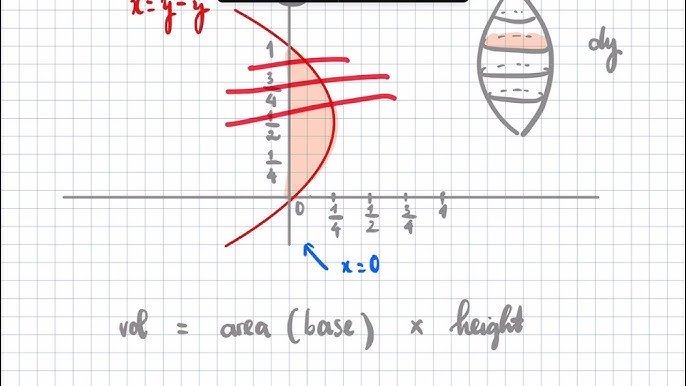
The disk and washer methodshelp find volume of solids by slicing them into thin disks or washers. Each slice is a circle or ring. Adding their volumes gives the total volume.
The shell methodcuts the solid into thin cylindrical shells. It works well when the solid rotates around an axis. Summing the shells’ volumes finds the total volume.
Step-by-step Calculation Guide
To find the volume of a solid, first identify the shape and boundaries. Understand if the solid is made by rotating a curve or stacking shapes.
Next, set up the integral that represents the volume. This usually involves finding the function that defines the shape and the limits of integration.
Common methods include:
- Disk method for solids of revolution with circular cross-sections
- Washer method when there is a hole in the middle
- Cylindrical shells for solids rotated around an axis
To solve the integral, apply the correct formula and compute the definite integral. Use basic integral rules and calculate carefully.
The result gives the volume of the solid. Always check your limits and units for accuracy.

Credit: studyx.ai
Common Mistakes To Avoid
Using incorrect limitscan lead to wrong volume results. Always check the bounds of integration carefully. Limits must match the problem’s region precisely. Misplaced limits change the shape and size of the solid.
Misapplying formulasis another common error. Each formula fits a specific shape or method. Using a formula for the wrong solid or method results in errors. Understand the formula’s purpose before applying it.
Ignoring units causes confusion and mistakes. Volumes are often in cubic units like cubic meters or centimeters. Mixing units can give wrong answers. Convert all measurements to the same unit before calculating.
Practical Examples
The volume of a cylinderis found by multiplying the area of the base by its height. The base is a circle, so the area is π times the radius squared. Multiply this area by the height to get the volume.
The disk methoduses thin disks stacked together to find the volume of a solid. Each disk has a small thickness and a radius that changes with height. Adding the volumes of all disks gives the total volume.
The shell methodwraps thin cylindrical shells around the axis. Each shell has a small thickness and height. Adding the volumes of all shells finds the total volume of the solid.
Credit: www.gauthmath.com
Frequently Asked Questions
What Is The Volume Of A Solid Generated By Rotation?
The volume of a solid generated by rotation is the space enclosed when a shape revolves around an axis. It is calculated using integral calculus methods like the disk or shell method. This volume helps in understanding 3D properties of rotated shapes.
How Do You Find Volume Using The Disk Method?
The disk method calculates volume by slicing the solid into thin disks. You integrate the area of each disk’s circular cross-section along the axis of rotation. This method is best for solids with circular cross-sections perpendicular to the axis.
When Should I Use The Shell Method For Volume?
Use the shell method when the solid is generated by rotating around an axis outside the region. It involves integrating cylindrical shells instead of disks. This method simplifies volume calculation, especially for hollow or complex shapes.
What Is The Formula For Volume Of Solids Of Revolution?
The volume formula depends on the method. For disks, volume = π ∫ [radius(x)]² dx. For shells, volume = 2π ∫ [radius(x) × height(x)] dx. Both require setting limits based on the region and axis of rotation.
Conclusion
Understanding the volume of solids can seem tricky. It helps in many practical tasks. Knowing the formulas simplifies complex problems. Practice leads to better understanding and accuracy. Start with simple shapes. Gradually move to more complex ones. This approach strengthens your math skills.
It boosts confidence too. Consistent practice is key. Everyone can master it with time. Remember, patience is essential. Keep learning and exploring new methods. Mathematics is a vast field. Enjoy the journey of discovery. Solids have fascinating properties. Dive deeper to uncover them.
You’ll be amazed by the possibilities. Keep calculating and stay curious.